

ShowYourLearning.com
For Students & Schools
Making the entire learning journey count.
Solving AI cheating and cognitive offloading by making the process matter, including constructive, accountable AI use.
Visit showyourlearning.com→You're one of the first people joining the hub.
You’ll also gain access to ’s Collections, Discussions, Library, and more — and also get recognized for the helpful content you share.
This hub’s main subjects are:
This hub’s personal interest subjects (shared casual interests) are:
Reading you do on these subjects that you save publicly, will be shared with this hub. To edit this / view advanced filtering, click here.
Now your expertise and interests can be recognized, leveraged, and members with similar interests can find you within . You’ll also gain access to ’s Collections, Discussions, Library, and more.
Let’s make this work in a way you’re 100% comfortable with:
Don’t overthink it, you can edit these later.
Choose an avatar for your Hub
Loading...
Our patent-pending, privacy-first technology is like fitness tracking for knowledge. It allows you to understand yourself in new ways, turn the best of your passions into employer-ready certifications, and for communities to craft experiences where human competence and effort matter.
We're using it to unlock a new internet and society
where knowledge can finally beat noise,
where human effort beats AI slop.
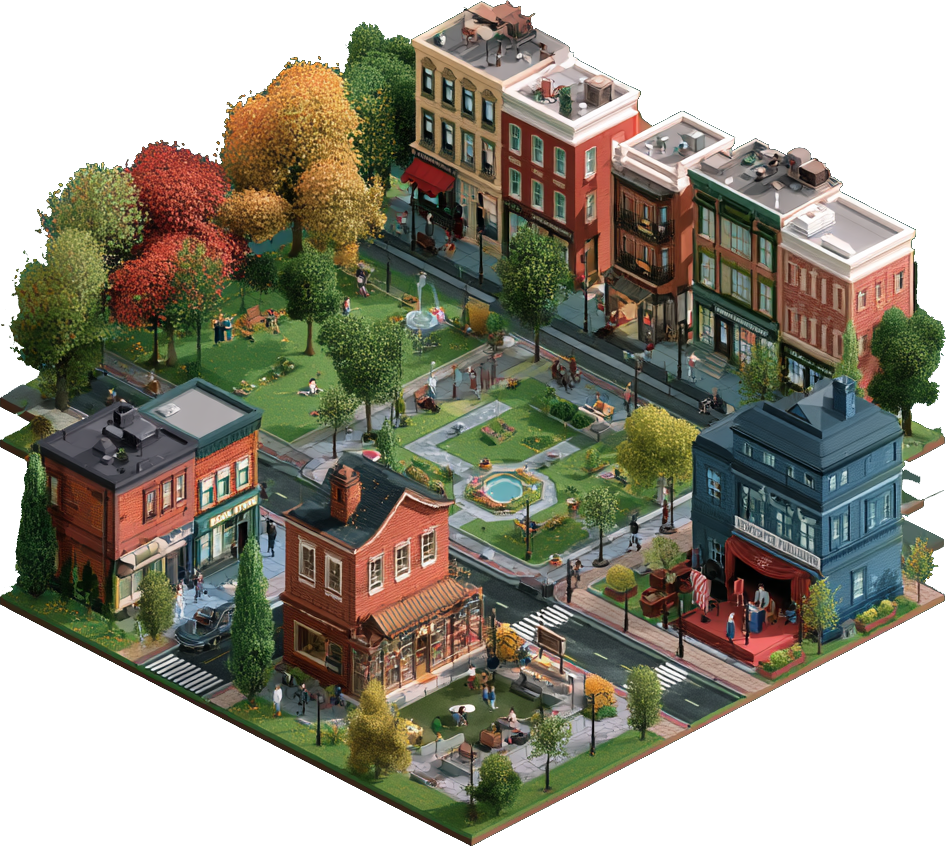

The world increasingly looks, and sounds, and feels like the above images because of the single underlying infrastructure defining our society today.
Today’s society is dominated by a single infrastructure: the infrastructure of the attention economy. It defines our culture, our discourse, and our economy. If you ask any child or adult today, “what does it mean to be popular?”, you will hear many variations on the theme of “getting attention”. Having many followers, getting likes, knowing how to dance. It is highly unlikely you will hear anything about being well-informed or intelligent. In this system, popularity, and the power it brings, are not formally a function of either. It’s often the opposite.
Society’s greatest challenge — and opportunity — is that we have built up this powerful system for measuring and rewarding attention, continuously and integrated everywhere, but have no comparable system for measuring and rewarding knowledge. This is because our attention is measured in a very particular way: we can transparently see and reward somebody’s ability to grab attention, but not how they’ve invested their attention. I.e. what their commitment or credibility on a subject is, in the same transparent, continuous, integrated way. (Our education system is the polar opposite on all 3 fronts.)
This damages the quality and efficiency of everything in our society, from our economy, to our media, to our politics, to our thinking. If we want a smarter, saner world, we need to be just as easily and transparently motivated by the attention we give, not just the attention we get.
Creating a system that can do this can change everything. Keep scrolling to see how.
↓Start exploring the impactToday, social media has mastered the idea of playing to people's egos through likes, followers, etc. Readocracy is mapping that recognition and sense of self to how informed you are on a subject, and how you can present that and be recognized for it. Media will benefit the most from rewarding people for the quality of attention they give, rather than just quantity of attention they can get from these same people.
Hand-in-hand with the shift in social media will be the inevitable transformation of the media landscape. Until now, focusing on well-researched longer content was a disadvantage. You were throwing away ad dollars. Increasing volume and making it more provocative was the way to win. It was a well-known, almost inevitable race to the bottom. It has defined the internet, our media, and our popular culture.
For the first time, we will see what happens when there is a viable alternative: an incentive for a race-to-the-top. When the content you consume can be tied to your public identity, social status, social inclusion, rewards, and economic mobility. Every crappy, I’d-rather-people-didn’t-know-I’m-reading-this page will now have an opportunity cost. In the past, it didn’t. The inverse will be true, too.
We have been used to living in a world where content, no matter how good, has been a "nice to have". The value was intangible. There has been no reason to prioritize it financially. We will see what happens when there is.
Until now, we had our attention extracted. Web3 already showed the appetite for a more equitable model. Where all the time we invest can count. Social platforms won by turning audience time into accrued identity value: status, personal recognition and representation, and connections that feel meaningful. Publishers will now have this at their disposal.
In 10 years, every internet user will expect to not just have their attention extracted, or justified, but rewarded and recognized.
↓Next: A.I. that benefits the manyBig Tech already got rich off our data once. They obsessively measured what we spend time with, the subjects we love, and what gets us to react. We received none of that data and insight as users, while it was used to prop up their nearly trillion dollar companies.
Generative A.I. represents a second attempt to do the same thing, to create the next crop of trillion dollar companies built off the content and activity of people. Just as before, there is a world of value to be had if people were equipped to make use of the data themselves.
Thanks to platforms like Readocracy, in 10 years every internet user will have the means to license and monetize their data for LLMs, to license their own A.I. assistant trained on all their research and knowledge and, most importantly, benefit from their own A.I. assistants.
↓Next: education is redefinedThere has been an ugly truth in the education model: by making education only formally matter in the context of school and work, we openly implied it didn’t really matter the rest of the time. To wonder why, to paraphrase Jonathan Haidt, “the last 10 years of American life have been so uniquely stupid”, is to be brushing at the tip of the iceberg.
What happens when your education, particularly how you show it, isn’t just a function of school? What happens when it doesn’t just matter at school and at work — but instead can meaningfully change your experience on Discord, on Reddit, on Linkedin, and everywhere else?
We are already witnessing the inevitable unbundling of Education with a capital E. The internet took away the powers of the information gatekeepers: you could now gain access to the world’s educational content for free! What we didn’t take into account was that without being able to prove the quality of that learning, we would still be dependent on the old gatekeepers to demonstrate our supposed knowledge.
Thanks to A.I.-powered assessment, the existing push for LERs (Learning and Employment Records), and — critically — platforms like Readocracy, we will see a dramatic shift in the roles of formal education, and the power of informal education. We will experience a future where our learning can count all the time, and everywhere.
↓Next: a new world for talentToday, the labour market is artificially constrained. This is obvious: we somehow simultaneously have employers bemoaning the difficulty in finding talent, while perfectly capable people struggle to find jobs. Why is this?
It is because we have an archaic throttling mechanism sitting at the center of our economy: instead of what we know (and are capable of) being real-time and fluid, it is sent through slow, 1,000-year old, pre-internet bottlenecks like academic programs. The fact their formal output is associated with a symbolic piece of paper — with zero data or means for easy verification — says it all.
What happens when what you know and can do is turned into data that is compellingly presented, verifiable, transparent, with strong credibility signals, and effortlessly searchable? What happens when a kid in the middle of nowhere, who has proven their learning and impact, can be found and hired/contracted despite not having a degree or job experience?
This is the coming future we can expect when how we inform ourselves and how we impact others can formally and continuously count. When the middleman is finally eliminated from the labour equation, and talent begins flowing through data, instead of bureaucracy — for individuals, within organizations, across organizations, and across the economy as a whole.
↓Next: work where we shineIt is often said that meritocracy doesn’t exist. The arguments are fair: the system is rigged to benefit the loudest voice in the room, the one which can pay to acquire the often expensive symbols of competence… in short, where power can be bought, not earned.
The crux of the problem is this: competence is often quiet. If you are an introvert, or uniquely intelligent, often doubly so. So: what happens when being quietly good is automatically loud?
In a world where our knowledge and influence are no longer trapped in invisible silos, where our competence is extremely, unavoidably visible, our recognition and opportunities transform. Instead of needing to “play politics” to gain power, expertise and impact will have their own direct power, transforming the world of work as we know it.
↓Next: politicians that can be trustedThrough all of the above changes, it will no longer be so effortless to acquire power through populism and empty words. Influence will be earned. Credibility will be tested. We will have the capacity to easily ask: do they know what they’re talking about, or are they just out to agitate us? This kind of transparency is lethal to the concept of “playing politics”.
Part of the collapse in the trust of institutions and institutional leaders can be attributed to the lack of transparency we have in understanding the decisions and motivations they have — or even the perception of access to their processes.
Today, we expect to see Twitter/X handles on our broadcasts, to find our candidates online. But rather than scheduled, contrived talking points — today so often inflammatory or divisive — we should demand visibility into the research and rationale that is driving their claims and will shape our future.
In a world where it is normalized to be tracking your knowledge, and presenting it and integrating it wherever it matters, it is only natural to expect that in the same way we have an expectation of tax disclosures today, we expect an equivalent disclosure around their knowledge of the positions they are arguing for or against. Allowing us to see for ourselves how informed or ignorant they are, how consistent or knowingly deceptive they may be.
↓Next: society’s new renaissanceIf you’ve made it this far, and you’ve already read how our social media, media, education, work, and politics can change, it should be obvious by now that this means an entirely different society.
This is the reality: in 10 years, if we ensure that how we inform ourselves matters formally in society, we will have a chance to usher in a veritable renaissance. One where the most informed, helpful, balanced people are rising to the top. Where our motivations, both our own and those impressed upon us by the media environment, are constructive instead of divisive. Not out of some altruistic agenda, but out of their newfound economic and social viability.
Imagine it, really. The calm. The rewarding connections. The increased conviviality and reduced defensiveness. The incredible reduction in noise. The rekindling of our individual and collective intelligence and integrity.
This is the future we can have. And it starts with making how we inform ourselves matter. It starts with a new infrastructure that makes it matter. It starts with Readocracy.
↑Back to top
Solving AI cheating and cognitive offloading by making the process matter, including constructive, accountable AI use.
Visit showyourlearning.com→
The only AI literacy platform that lets anyone catch up and prove themselves. Anchored in critical thinking instead of hype.
Visit thinkingthrough.ai→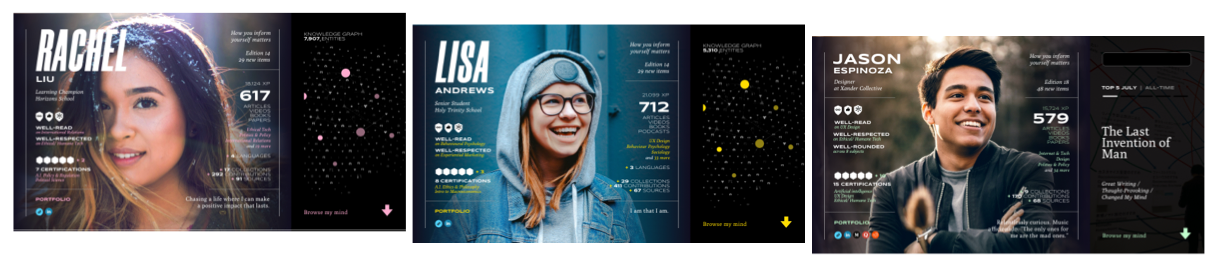
Bringing the original vision to life for the AI era: a privacy-first fitness tracker for how you feed your mind, including LLMs. Understand your information diet, present the best of it, and connect with a community of real people verifiably investing in their passions (instead of an army of sloppers chasing likes at any cost).
Coming soon
Applied research into how what we consume shapes how we think, feel, and decide, individually and collectively.
Coming soon
Social media where the quality of attention you give matters as much as the quantity of attention you get.
Right now, our feeds can only be optimized around grabbing attention. There’s no way of optimizing for subject matter expertise. Think: how would you sort your feed for credibility? How could the platforms?
Today we can’t, resulting in status and power being attached only to distraction. The quality is formally irrelevant. Readocracy makes it a formal component that can be used in algorithms as well. Turning the effort we put into educating ourselves on a subject, and the credibility, breadth, and balance of what we share, into status instead. Transparently and fairly.
In other words, the future of social media includes an incentive to spend time with, and share, the most credible, informative content, rather than only the most provocative. Add this to the inevitable rise of algorithmic control — something Readocracy is pioneering alongside a rising tide that already includes Bluesky — and we can count on a future where social media isn’t mindless, but mindful. Normalizing awareness, intentionality, and context, rather than the status quo that avoids all three.
↓Next: thriving quality journalism